On
Saturday, March 14th 2015, artist Kirk Palmer and sociologist
Yoshitaka Mouri met with Art Action UK to discuss the impact of nuclear power
in Japan, and to consider the ways in which we form both individual and
collective memories following nuclear disasters.
The discussion event took place at
White Conduit Projects in London and was part of an exhibition and series of
events entitled Those Who Go East.
Curated by Art Action UK, Those Who Go East commemorated the earthquake
and tsunami in East Japan in March 2011 and the on-going nuclear
meltdown. Those Who Go East featured artists who live and
work in East Japan as well as artists who have been there to make work in the
areas affected by nuclear radiation. It explored the ways in which
artistic practices might reflect, inform and influence our social and political
responses to nuclear catastrophes.
The following article brings
together themes and ideas discussed during the event. It considers the
social impact of the nuclear meltdown in East Japan, and how artistic responses
reflect on and influence the creation of individual and collective memories.
On March 11th 2011 an
earthquake and tsunami hit East Japan and damaged 3 of the 6 nuclear reactors
in Fukushima Daiichi Nuclear Power Plant, causing the largest nuclear meltdown
since the Chernobyl disaster of 1986. The power plant had been
commissioned in 1971 and was built and operated by Tokyo Electric Power Company
(TEPCO).
In a New York Times article
reflecting on the events of 3/11, Robert Jay Lifton, author of Death in
Life: Survivors of Hiroshima and lecturer in psychiatry at Harvard Medical
School, stated:
‘There was resistance [to the
Fukushima Daiichi Nuclear Power Plant], much of it from Hiroshima and Nagasaki
survivors. But there was also a pattern of denial, cover-up and cozy
bureaucratic collusion between industry and government.’[i]
This pattern of denial has extended
to include the nuclear meltdown in 2011. And as time passes, there is an
increasing sense of collective amnesia regarding the risks of nuclear energy
production.
In Japan, the expression huuka
is used to refer to the waning media coverage of the nuclear meltdown in
Fukushima. Huuka originally has geological meaning; literally
translated, it means ‘weathering’ or natural erosion. When used to
describe a social consciousness however, it indicates the gradual slippage of
memory. The expression huuka signifies a deep sense of loss,
rather than simply a memory lapse.
Huuka is less apparent during the month of March as media
reports focus on the commemorative actions and events taking place in Japan and
globally. However, despite the fact that Fukushima is still a no-go
zone and the plant continues to leak nuclear waste into the ocean, the issues
surrounding the nuclear meltdown are covered as if they are in the past.
Dr. Yoshitaka Mouri is a sociologist
and critic from Tokyo University of the Arts who has been researching the role
of art and music within activism, with a particular focus on the protests
following the nuclear meltdown. He explains; ‘It’s not as though
the memory has been eroded naturally, but it’s more as if there is a kind of
‘will’ or ‘conspiracy’ to want to forget.’
But there are two kinds of huuka.
One can mean a wilful forgetting; knowingly allowing memories to be weathered;
and the other can refer to an erasure of memory that is needed to
survive. The latter perhaps relates to those directly affected by the
disaster, who, despite a deep sense of loss, have to focus on immediate,
day-to-day needs. But the former is also of social concern, because this
surrendering of memory can have a negative psychological impact and, when
experienced on such a large social scale, it can have on-going repercussions.
‘It feels as though society in Japan
is suffering from a psychological illness of wanting to forget. People
don’t talk about it or discuss it, but anxiety is always there’ Mouri reflects,
‘it is particularly acute for young families and people bringing up children.’
Nevertheless, many people who live
in cities further afield may not feel this anxiety. The government
create a sense that everything is ‘okay’, and although protests against nuclear
energy production continue, the media rarely covers them.
Mouri explains that in Tokyo, two
worlds coexist side by side without touching each other. One world is
concerned with the nuclear meltdown and the other carries on
obliviously. ‘They are almost like parallel worlds’ states
Mouri. But it is possible to bridge the gap between these worlds, and for
Mouri and many other artists, writers and musicians, creative cultural projects
can do this more affectively than traditional activist protests.
Kirk Palmer is a British artist
whose works reflect on the nuclear bombings of Hiroshima and Nagasaki in
1945. His work explores the question of what places still hold of past
events and past traumas, and his recent exhibition at The Daiwa Anglo-Japanese
Foundation- Remembering Absence- featured moving image works and
photography created in Hiroshima, Nagasaki, and Yakushima. His recent
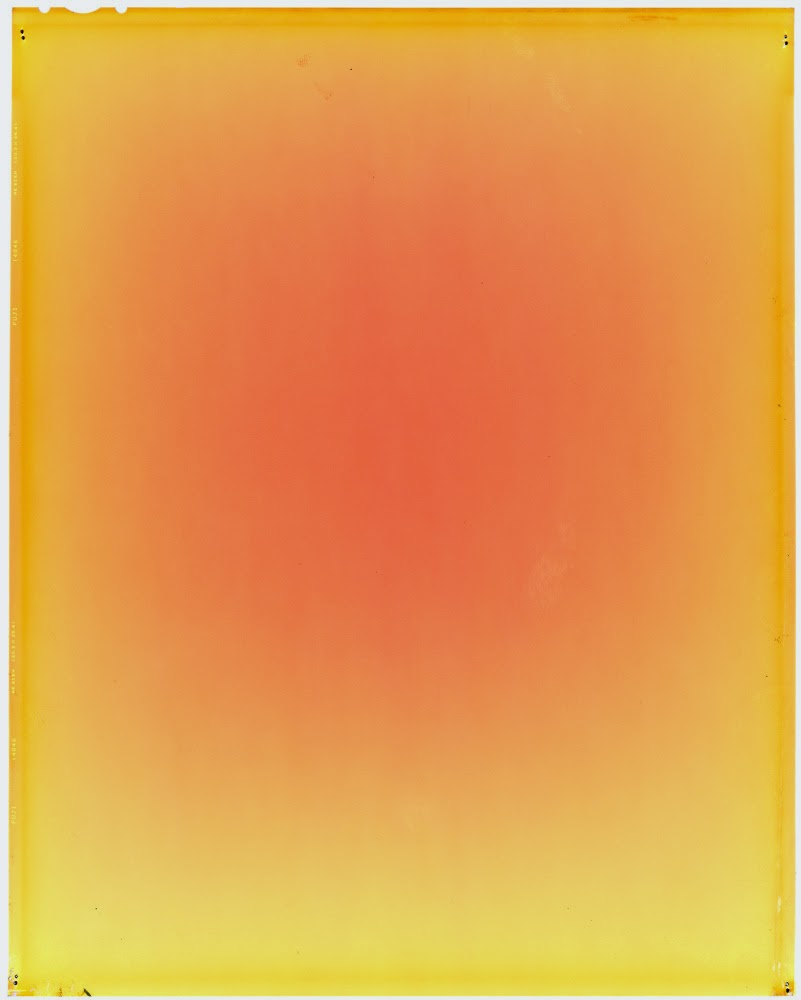
photographic series Precious Fragments features images that ‘attempt to
rekindle’ something of these places. The images have a mysterious
quality; they appear to ‘reside between an ambiguous historical time,’ no
longer anchored in the present moment.
Palmer emphasises that his works are
individual attempts to reflect on the atomic bombings. His works form
spaces that facilitate a process of contemplation and Palmer carefully avoids
telling viewers what to think. ‘The works are quite open in a sense
that people can bring their own knowledge, thoughts and feelings about those
events to the works,’ he explains. These works allow people to step out
of their day-to-day routines and re-engage with their own memories. The
nuclear bombings created levels of radiation in the environment that were
deemed unsafe for a few weeks. Nevertheless, the impact on the physical
and mental health of the survivors continues to this day. By asking us to
contemplate these repercussions, the work provides a ‘bridge’ between the two
worlds Mouri speaks of- the oblivious world of everyday habit and the world
that acknowledges the invisible impacts of nuclear catastrophes.
Palmer’s interest in themes of
memory and trauma began when he was a student at the Royal College of Art,
where he was awarded a scholarship to go to Japan for three months. This
was summer 2005, which marked the 60th anniversary of the nuclear
bombings. During this time, Palmer lived on the outskirts of Kyoto, with
views across the city delta. These images of the landscape called
to mind the aftermath panoramas of Hiroshima and Nagasaki by Shigeo Hayashi.
Palmer started to read about the
atomic bombings in more detail and quickly learned that Kyoto had originally
been a target for the bombs. Faced with such a huge and sensitive
subject, he tentatively created Murmur, a film featuring bamboo groves
in Kyoto and Hiroshima, which he describes as an ‘oblique representation’ of
his contemplation of the bombings. This marked the start of a ten-year journey
of learning about and reflecting on these events.
 |
Film still from Murmur (2006) © Kirk Palmer
|
The following year, Palmer returned
to Japan to make Hiroshima. He wanted to explore the process of
‘reaching’ the atomic bombings from a distance of 60-70 years and as someone
from a different part of the world, even though from the outset he acknowledged
that this was ultimately impossible. Central to this work is a desire to
facilitate empathy, initially within himself, but by extension the viewer.
 |
Film still 3 from Hiroshima (2007) © Kirk Palmer
|
The sense of huuka is very
much part of Hiroshima. Palmer explains; ‘I had a historic image
of Hiroshima but hadn’t stopped to think of what it was actually like. So
it was quite a shock to find such a beautiful city, and outside of certain
designated areas, very little to remind you of what happened. But
strangely that absence put me more in mind of it.’ Palmer describes this
as a ‘conspicuous absence’, and he wanted to film these ‘forgetful
spaces’. For this reason he avoided filming memorials or
using direct images of the bombings. Direct imagery is important and
significant, but Palmer’s works refrain from using imagery that risks being
confrontational. However, the very title ‘Hiroshima’ alludes to a
history that brings with it a set of images that varies with each viewer.
The conspicuous absence of direct imagery within the artwork is an intentional
strategy because it creates a counterpoint within the mind of the viewer,
rather than in the artwork. In this way, the stark absence of the tragedy
within the artworks extends contemplative time rather than provoking a
knee-jerk reaction.
Artists are increasingly addressing
the issue of huuka; on 11th March this year- a group of
artists including artist collective Chim Pom and Ai Wei Wei collaborated within
a prohibited area of high radiation in East Japan to create twelve artworks
under the title Don’t Follow The Wind. Described as an
‘inaccessible exhibition’, the twelve projects can only be viewed when the area
becomes safe to live in again; ‘which may be beyond our lifetime’[ii].
These works become part of a kind of time capsule, a visual reminder that will
surface in the future and recall the latent dangers and anxieties of the
nuclear meltdown. And they also serve as a social critique, highlighting
the lack of knowledge and of transparency surrounding the nuclear
clean-up.
Following the disaster, TEPCO
installed a 24/7 live camera on the Daiichi power plant, to give a sense of
transparency, a sense of openness. However, this illusion is obsolete, as
it has recently emerged that a huge amount of radioactive water has been
released into the sea. Mouri explains ‘There is a widespread perception
that within the [government/ TEPCO] power structure that there are things that
are hidden.’
New York-based Japanese writer and
translator Sabu Kohso provides a strongly oppositional, even anarchic, voice
within current discourses on nuclear energy production. Kohso
explores the wider impact of nuclear energy use, understanding it as a weapon
of state control and capitalism. In an article entitled Turbulence of
Radiation and Revolution, Kohso states 'All conduct of the Japanese
government in the wake of 3/11 has proven that the state would choose
continuation of capitalist operation and its own sovereignty over the
well-being of the people. It has been constantly blurring
information about present risks of radiation and critical conditions of
the power plants' [iii]
Day-to-day anxiety regarding
radiation is suppressed using misleading data and over-confident rhetoric, but
this does not dispel the issue. Kohso writes 'Radiation is gradually and
steadily permeating every corner of the social space via metropolitan
functions such as circulation, exchangem and transportation at the same time as
it is being carried around by all atmospheric activities, including wind, rain
and oceanic currents.' [iv]
The global issues surrounding our
dependency on nuclear power production, and the pervasive capitalist systems
that determine energy politics are, for many of us, overwhelming and
paralysing. Can art communicate in a way that can have a social
impact? If so, how? This is a huge question for the artists and
writers who address micro-political themes surrounding nuclear energy, as well
as artists whose work acts as a social critique.
For Kirk Palmer, his work is an
initial step on a shared journey; an exploration of memory and trauma that
enables increased understanding of these events. ‘I’m representing
the space that allows people to make their own observations and enter into the
work in a similar way to me,’ he explains. ‘It’s an empathetic
process. It’s important that lessons are learned [from the bombings], but
part of that process is first of all feeling something and then setting about
understanding it as well as you can.' These processes of feeling and
understanding are necessary steps to allow for changes within the wider social
consciousness.
As Dr. Yoshitaka Mouri points out,
cultural practices can form a ‘bridge’; a communicative passage that
facilitates a flow of ideas and knowledge between different individuals and
groups of people. Whilst not immediately political, they can influence
the way we understand and respond to political issues. Cultural practices
can create shared spaces that not only bring people together, but allow for a
kind of social engagement that generates a sense of freedom and emancipation.
The wider social impact of these cultural practices cannot be measured in
concrete terms, but instead they perpetuate the creation of new social
zeitgeists that demand new and responsive political reforms.
Kirk Palmer: Palmer studied at the Royal College of Art in
London. In 2006 he won the The Conran Foundation Award and has
since been shortlisted for awards including the London Artists' Film and
Video Awards (2007) and the Salon Video Art Prize (2010). His recent solo
exhibition at The Daiwa Anglo-Japanese Foundation was entitled Remembering
Absence and his work has been featured as part of the current Conflict,
Time, Photography exhibition at Tate Modern.
Dr. Yoshitaka Mouri: Mouri is a sociologist at Tokyo University of
the Arts. His research explores contemporary art and urban space and cultural
and social movements. His publications include Culture=Politics: Cultural
and Political Movement in the Age of Globalization, Popular Music and
Capitalism, and Philosophy in the Streets.
[i]
Robert Jay Lifton, Fukushima and Hiroshima, APRIL 15, 2011, The
New York Times
[ii]
‘Don’t Follow the Wind’; www.dontfollowthewind.info
[iii]
Sabu Kohso, Radiation and Revolution, Borderlands E-Journal
special issue: Commons Class Struggle and The World
[iv]
Sabu Kohso, Radiation and Revolution, Borderlands E-Journal
special issue: Commons Class Struggle and The World